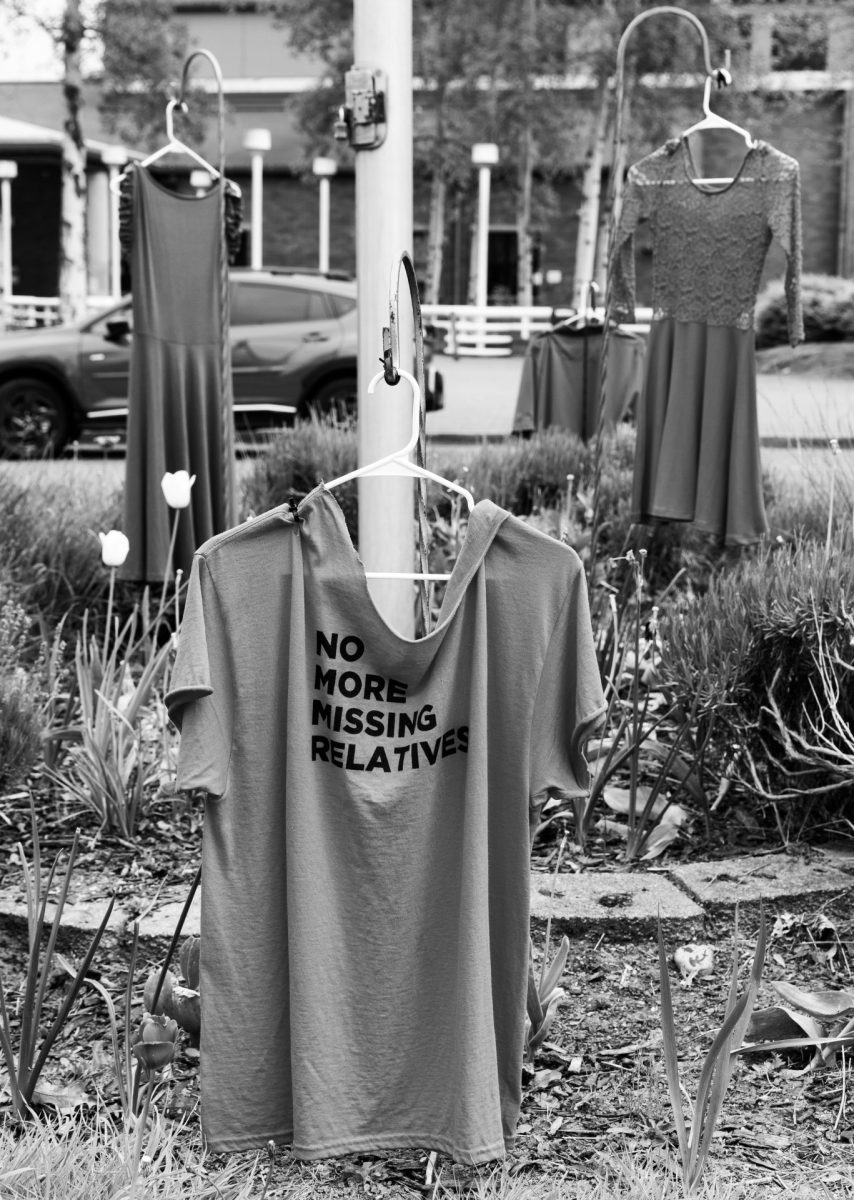
In honor of National Day of Awareness for Missing and Murdered Indigenous Women and People day, Terrace sophomore Liz Herrmann in harmony with Urban Native Education Alliance, put up a vibrant display in the roundabout in front of MTHS.
Bright red shirts and dresses were put up on hangers around the flagpole centered in the roundabout. Circling the dresses in the grass were signs put up, reading statistics and facts to raise awareness. The signs highlighted issues relating to missing indigenous people. One sign read “Out of 50 states only 13 have MMIP task forces.” A shirt hung by the flag pole had “no more missing relatives” written on it.
Liz Herrmann, a member of Sugpiaq, the Native Village of Eyak, spoke on her motivation for putting up the display. “‘It’s an extremely big problem in indigenous communities where Native women are exponentially more likely to experience abuse and things like rape or murder in their lifetimes, almost 10 times more likely than the national average for anyone else,” said Herrmann. A similar display was put up last year also made by her.
In 2016, 5712 indigenous people were reported missing. Out of these reports, only 116 were logged in the DOJ (Department of Justice) database. The Center for Disease Control and Prevention reports murder as the third leading cause of death among American Indian and Alaska Native women aged 10-24.
Washington is one of the few states that has a task force in relation to missing Indigenous persons. The Office for Victims of Crime (OVC) describes the objective, “The task force will assess systemic causes behind the high rate of disappearances and murders of Indigenous women and people.”
While Washington may have a task force, the majority of states do not. Currently only 13 states have them, despite very high rates of missing Indigenous people in many of the states not containing a task force.