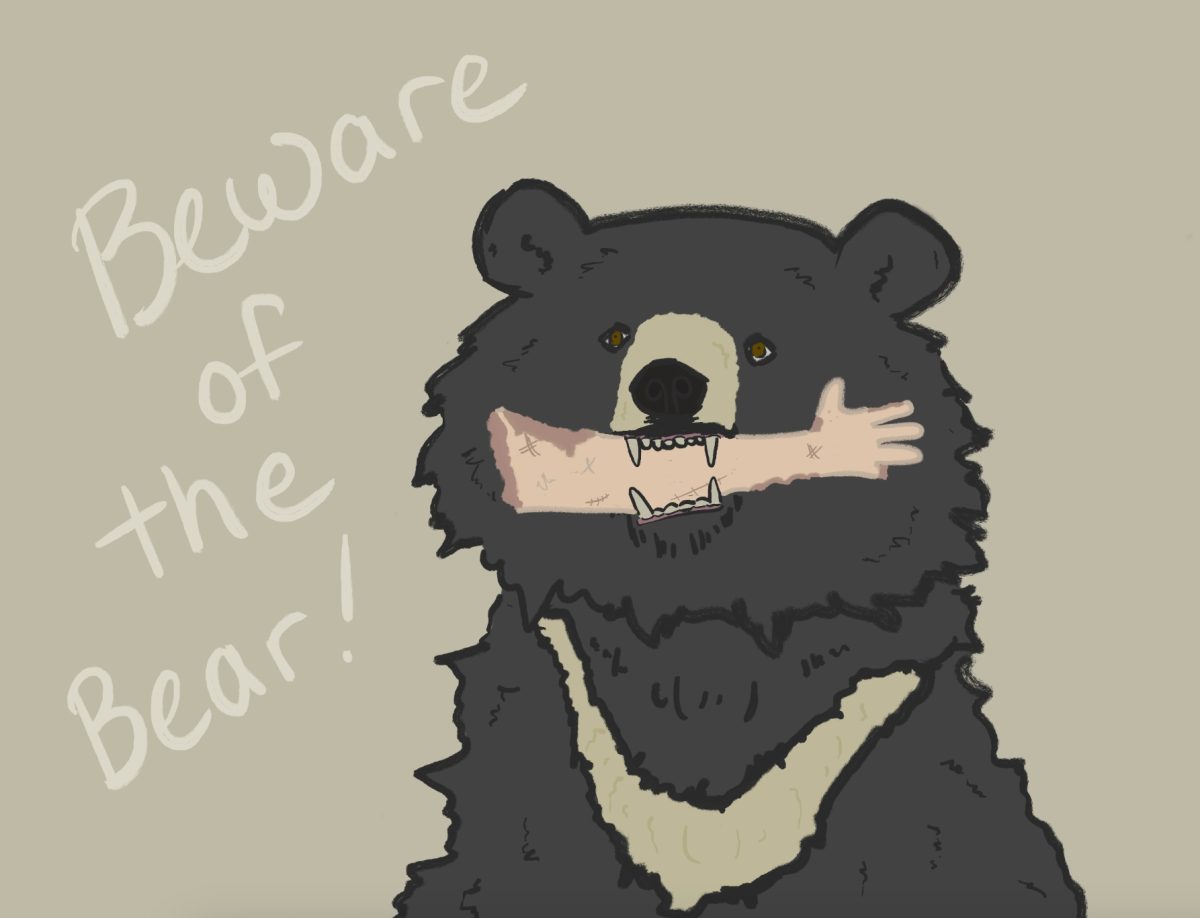
With some of its most well-known mascots Kumamon and Rilakkuma, it is safe to say Japan is no stranger to living among bears. Although a beloved icon, Japan’s bears have been notorious for their attacks on humans–with 219 attacks and six deaths in the 2023/24 fiscal year and so far, at least 13 people have been killed and more than 100 have been injured in the 2024/25 fiscal year. Over the last few years, bear attacks have only increased, compared to the average of 50 attacks per year in the 2000’s to the 200 today.
To investigate why such a rapid increase is happening, it is first important to identify the features of the bear living in Honshu, the main Japanese island where these attacks are most common. (For those who don’t know, this is most of the longer island of the two main islands and contains Tokyo, Kyoto, Osaka, Kobe and other notable cities) The most common species of bear in Honshu is the Asian Black Bear, specifically a subspecies called the Japanese Black Bear, known for its smaller size, black fur, and iconic off-white crest on the chest area. One of its tendencies that make them more prone to attack is their lifestyle; they tend to live in more secluded areas compared to brown bears, who live in more open spaces. This makes them more likely to be surprised by the presence of humans, leading to attacks on humans in an attempt to protect themselves. One thing to make note of is that Japan is a small country with a relatively large population for its size; while being approximately the size of California, an already heavily populated state, Japan has three times the population. This means higher population density and thus, higher rates of human-bear encounters.
It is also important to note that the bear population has generally increased due to both natural and artificial factors. In the late 1900s and early 2000s, Japanese Black Bears were considered endangered, which started conservation efforts in Japan to increase their populations. Due to successful efforts, bear populations tripled in 11 years from 2012 to 2023 and now settled at a comfortable 42,000. It has also been stated by many environmental experts in Japan that bear populations boomed last year due to the abundance of their food sources, which has now dwindled due to bad weather and the increase in bear populations. The main source of food for bears is the fruit of the Japanese beech tree, which is part of the acorn family, and have mast years, which are years where fruit production is purposefully abundant- this is to ensure that some seeds, uneaten by animals, can grow into the next generation of trees. Mast years happen every 5-7 years for the beech tree, which means they fluctuates around 4-6 times within the average bear’s life. However, as a side effect, mast years tend to cause an increase in the animal species nearby the following year, as the females, who get plenty of sustenance during the mast year, decide to mate and eventually have offspring. However, since mast years only happen every couple of years for most species, it means that the year after, many animals have trouble adjusting to the amount of food available. This leads bears to venture out of their normal habitats in order to forage, where they encounter humans, infrastructure, and human food.
The main characteristic Japanese experts state that differentiates this year’s bears to any others is their recklessness and lack of fear towards humans and rural and urban areas. Observations include that the bears have been ignoring gunshot sounds, the sounds of pots and pans, and high-pitched noises which would have, in previous years, been enough to chase most bears away. They suggest that this is the case because, combined with the need for food, those noises have been nothing but threats over the years- guns are rarely used in Japan. (and are reserved for hunters and special police). Other suggestions include conversations surrounding Japan’s urbanization and elderly population. Japan currently has a low birthrate, large elderly population, and declining population. This has led many environmental sources in Japan to suggest that the death of Japan’s elderly population and the yearning of the younger population to move to urban areas/out of the country entirely is leaving whole towns and villages behind. Thus, meaning wildlife, including bears, have begun to access houses that still have human food, tools, and sometimes even electricity and running water. In conclusion, the connection between the two variables is desensitization. The new generation of bears has been desensitized to environments where humans regularly live and have become comfortable barging into houses and interacting with humans in search of food they need during a time where there is less food and a large population.
The question many Japanese people have on their minds is, “when will this end?” For many, especially living on the country-side, bears have become a valid concern regarding safety.
Luckily, experts at Iwate University suspect that this will last until mid-December, though most adult bears will be in hibernation by the end of November–the only concern they have is cubs coming down the mountains last-minute in search of food or their mothers. This is to say, if you ever encounter a black bear, it is advised to back away while facing towards and making eye contact with the bear. However, if you are being attacked, it is best to cover your neck with your hands whilst laying on the ground face and stomach-down to prevent harm to the vitals.