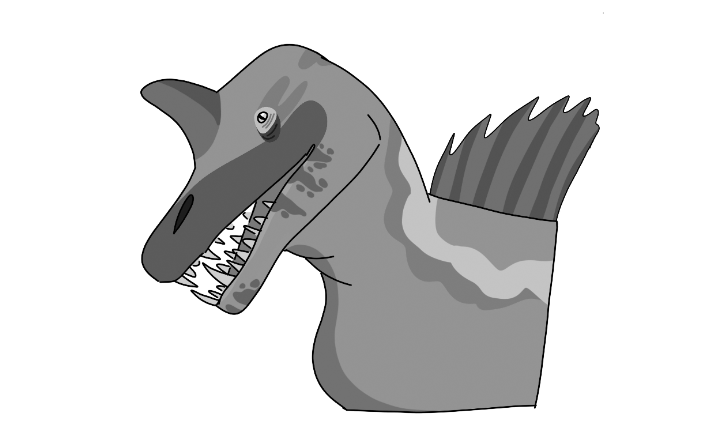
A new species of Spinosaurus was discovered, with its scientific name being Spinosaurus Mirabilis (with Mirabilis being Latin for marvellous), making it the second species of Spinosaurus to be discovered after over 100 years. It belongs to the genus of Spinosaurus, living around 95 million years ago in North Africa, during the Cretaceous period.
It would’ve been around 40 feet long and weighed five to seven tons. To clarify, the scientific name for the traditional/first discovered Spinosaurus is Spinosaurus Aegyptiacus, and the new Spinosaurus is Spinosaurus Mirabilis. To make things simpler, this article will refer to the old Spinosaurus as Aegyptiacus and the new one as Mirabilis.
Now, one commonly asked question is what’s different about Mirabilis than Aegyptiacus? Well, there are some big differences. The most obvious difference is that Mirabilis has a large pointy crest on top of its head, which is around two feet tall. The crest would have been covered in keratin, making it even taller when the animal was alive. Aegyptiacus also had a head crest, but it was much smaller and more rectangular. Aside from the head crest, Mirabilis also had a lower profile snout, a thinner but longer skull, and different spacing between its teeth. These adaptations were perfect for a piscivore diet (meaning it primarily ate fish), similar to what we believe Aegyptiacus would’ve eaten. However, further research is needed to determine how exactly it would’ve hunted, or if it had other kinds of animals in its diet. The first specimens of Mirabilis were unearthed in ancient river deposits in the Sahara Desert in Niger, while Aegyptiacus’s fossils have been found in Egypt and Morocco. Mirabilis lived in a lush river ecosystem, rather than the desert that is modern-day Niger. It also lived more inland than Aegyptiacus, meaning its lifestyle would’ve been a bit different.
Mirabilis’s discovery will hopefully aid paleontologists in their quest to better understand the genus Spinosaurus. Before the discovery of Mirabilis, scientists only had Spinosaurus fossils of Aegyptiacus to study. Aegyptiacus is famous for having one of the most controversial and confusing histories of any dinosaur, with its design and lifestyle constantly being changed and reworked. The original fossils in Aegyptiacus were discovered in 1914, being quite remarkable and surprisingly complete. However, they were unfortunately destroyed in World War II after a British bombing raid on the German city where the fossils were being kept. After that, many of the Aegyptiacus we found were very fragmentary, but that has started to change after the 1980s, as we’ve started to unearth more extraordinary Aegyptiacus fossils. However, this has led to how we depict Spinosaurus changing very rapidly.
For now, we know for sure it was semi-aquatic; we just can’t decide what that term means for Spinosaurus. Hopefully, the discovery of Mirabilis can help us better and more accurately paint the picture of Spinosaurus.