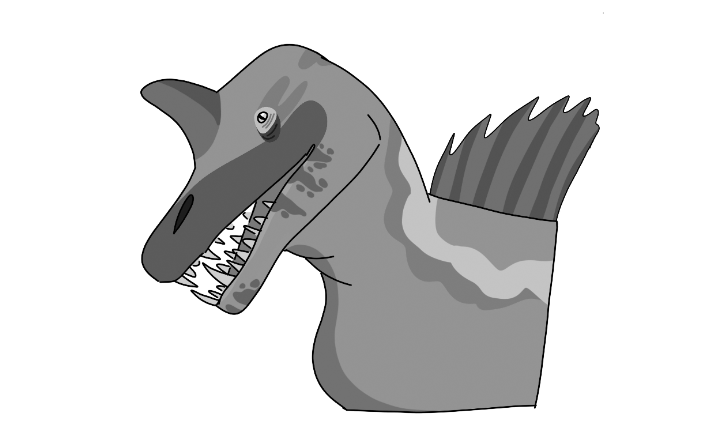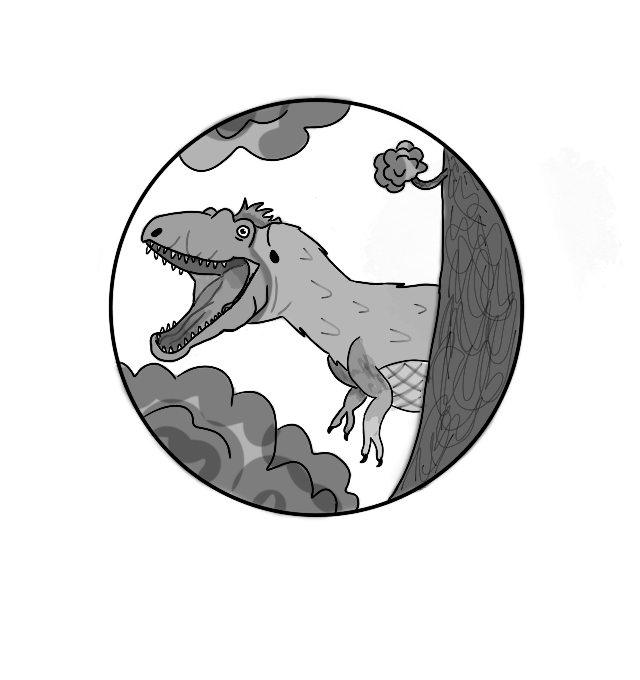
This year has been one of the most important years for Nanotyrannus. After years of being invalid, Nanotyrannus has once again become a valid species. For a long time, paleontologists have debated whether Nanotyrannus was a true species or if it was just a juvenile Tyrannosaurus rex. The main argument for the Nanotyrannus being valid is that its skull and skeleton are built slightly differently from those of the Tyrannosaurus. But it was commonly thought that Nanotyrannus was just a small T-rex. But in October of 2025, a paper was published by Lindsay Zanno and James Napoli, providing very strong evidence that supports Nanotyrannus’s validity. The paper mainly examined the “Dueling Dinosaurs” fossil.
The Dueling Dinosaurs is a remarkable fossil that was discovered in 2008 in Montana. The fossil contains a Triceratops locked in battle with a small Tyrannosaur (nicknamed Bloody Mary). At first, it was thought Bloody Mary was a juvenile T-rex. However, Lindsay Zanno and James Napoli claimed that Bloody Mary is actually a Nanotyrannus. The main evidence for this claim is the age of Bloody Mary’s bones. Young T-rexes gain serious weight around the ages of 12 to 13, and reach adult size around 18 to 20. However, after analyzing the bones, it was found that Bloody Mary is around the age of 17 to 22. Bloody Mary would have had to have nearly doubled in size for it to be a T-rex. This is very strong evidence that Nanotyrannus is a valid species.
To better understand the difference between the two dinosaurs, here’s a quote from CNN Science: “Nanotyrannus was 18 feet long, agile and built for speed, with long legs and strong arms to grasp prey, while 42-foot-long T-rex had stocky legs and used its devastating bite to devour huge, slow-moving dinos”. This shows how their fossils may appear similar, Nanotyrannus and Tyrannosaurus rex are very different animals.
Another fossil that the two paleontologists analyzed was Jane. Originally found in 2001, Jane was thought to have been a juvenile T-rex. However, Lindsay Zanno and James Napoli described how Jane was very similar to Bloody Mary, and is a Nanotyrannus. But shockingly, Lindsay and James have claimed that Jane is a separate subspecies of Nanotyrannus. Their reasoning for this is that Jane and Bloody Mary contain many notable differences in their fossil, which would mean the two fossils were still Nanotyrannuses, but different species of Nanotyrannus.
Though not all paleontologists agree with the claim that Jane is a separate species of Nanotyrannus, it is now widely accepted that Nanotyrannus is a true and separate species from Tyrannosaurus rex. And this has also helped us solve another mystery we had–for a long time, in North America during the late Cretaceous period, we haven’t found any small or medium-sized theropods. For a while, it was a mystery what animals filled this niche of the ecosystem, and we have had some theories in the past. For a while, it was thought that just younger, smaller T-rexes would fill this role. And then, in 2005, we discovered Dakotaraptor, the first medium-sized predator in North America during that time period. But now much debate has been done about whether Dakotaraptor is truly valid or not, as its holotype fossil might be a mixture of different species. So as of now, we aren’t 100% sure if Dakotaraptor existed or not. But now with this new evidence of Nanotyrannus, we can solve the mystery of medium-sized theropods, as Nanotyrannus would have perfectly fitted this role in its ecosystem.
After years of research and heated debates, the mystery of Nanotyrannus’s validity has most likely been solved. Much more research is needed to learn more about this elusive animal and how it lived during the Mesozoic era. Hopefully, we can learn more about Nanotyrannus in the future, as well as all dinosaurs in general. This is how we can learn more about the history of our planet, and how life was during this ancient and magnificent time period.